Is a MP3 Player with Spotify a Safe First Device for Kids?
A quiet question every parent eventually asks.
🎧 Optional: play something soft while reading — just to slow things down a little.
The moment every parent recognizes
At some point, your kid will look at you and ask:
“Can I have my own device?”
And it sounds simple enough.
But most parents pause for a second.
Not because the question is hard.
But because of what it actually means.
It’s not about the device.
It’s about this quiet realization:
your kid is starting to build a world you’re not fully part of anymore.
📱 The obvious answer is usually… a phone
Let’s be honest — most of us have done the math already.
There’s probably an old iPhone in a drawer somewhere.
Or a retired Android sitting on a shelf.
Charge it up, install Spotify, set it up… done.
Problem solved, right?
Except it rarely stays that simple.
Because a phone isn’t just a music player.
It’s:
- YouTube
- TikTok
- Games
- Social media
- And whatever else lives one tap away
And once that door opens, it doesn’t really close again.
🧠 What parents are actually worried about
It’s not “screens are bad.”
Most parents already gave up on that argument somewhere around 2016.
The real worry is quieter than that.
It looks more like this:
Your kid is in the next room…
But you have no idea what world they’re in.
You start noticing small things:
They laugh at things you don’t understand.
They pick up phrases from somewhere you never taught them.
They seem… just a little further away, even when they’re sitting right there at the table.
It doesn’t happen overnight.
It just slowly becomes normal.
🎮 And then there’s gaming
Every parent knows this one.
Because games aren’t just “fun” anymore.
They’re engineered to keep attention on a tight loop:
- win → reward
- fail → retry
- progress → dopamine hit
Every few seconds, something happens.
Something responds.
Something pulls you forward.
And real life?
Real life doesn’t really do that.
Real life is:
- practice for weeks before improvement
- effort before reward
- silence before progress
So it’s not surprising when kids start to feel like:
the real world is kind of… slow.
And games feel more immediate, more alive.
🎧 Why music still feels “safe” to parents
Here’s something interesting.
Even very anxious parents usually don’t panic about music.
In fact, they often prefer it.
They’ll happily give a kid a Spotify account.
Maybe even a dedicated device.
And maybe that’s because most of us remember it.
The songs we looped when we were teenagers.
The tracks that got us through breakups, awkward phases, late-night overthinking.
Music didn’t fix anything.
But it stayed with us.
It gave us something simple:
“You’re not the only one who feels like this.”
And kids don’t really change that much.
They just get quieter about it.
💛 Music vs. everything else
The difference isn’t specs.
It’s behavior.
A phone always wants the next thing.
One more scroll.
One more video.
One more hit of novelty.
Music doesn’t do that.
It just sits there.
It doesn’t interrupt you.
It doesn’t chase you.
It doesn’t try to win your attention back every 10 seconds.
You can leave it.
And it will still be there when you come back.

🏠 So the real question shifts
At some point, the debate stops being about features.
It becomes something simpler:
What kind of world is this first device opening for my kid?
Is it a world that is:
- fast
- loud
- always pushing the next thing
Or one that is:
- slower
- calmer
- a little more contained
🌙 Most parents don’t say it out loud like this
But if you listen closely, the answer is usually very simple:
“I just don’t want it to be too much, too soon.”
Not no technology.
Not no independence.
Just… not all of it at once.
🎧 This is where a different kind of device comes in
That’s why some parents have started looking for something in-between.
Not a smartphone.
Not a locked-down “toy.”
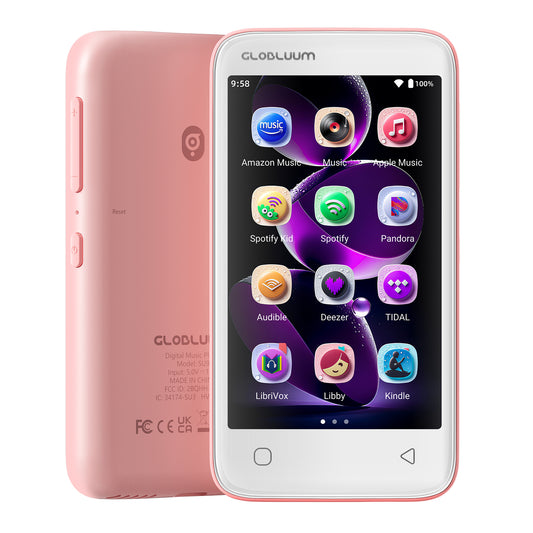
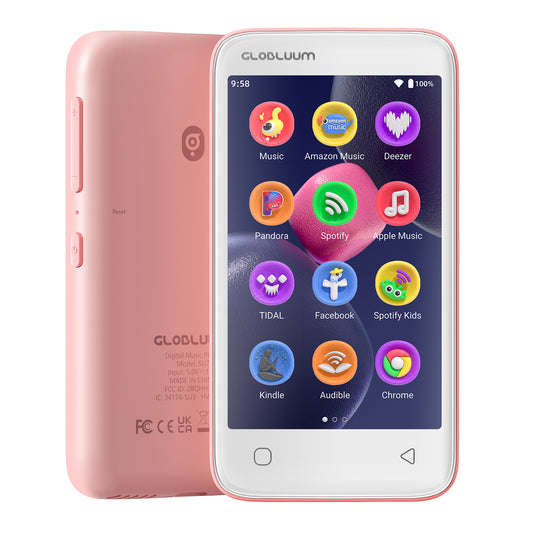
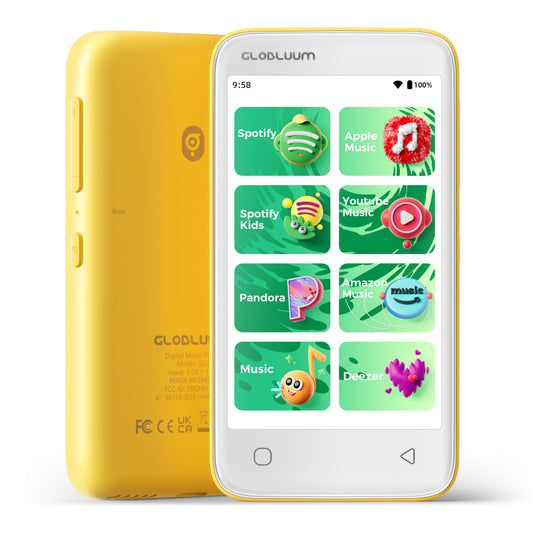
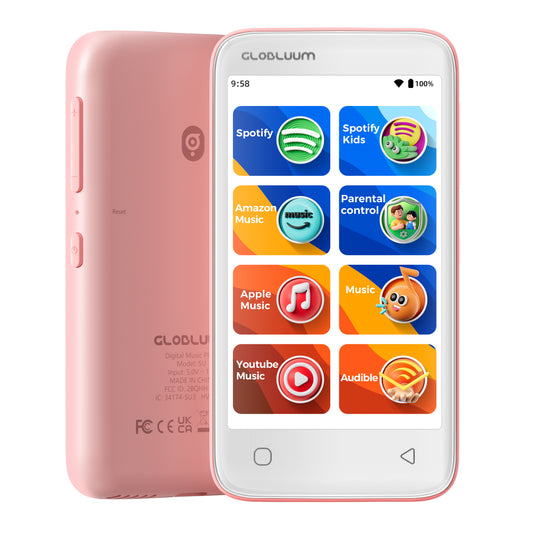
But a device that stays focused on audio, reading, and a controlled app environment.
Something that lets kids listen to Spotify, Apple Music, audiobooks — without opening the door to TikTok, endless feeds, and everything else competing for attention.
In other words:
music, not the entire internet.

🍃 A final thought
There’s probably no perfectly “safe” first device.
Kids will grow into the digital world anyway.
That part is unavoidable.
But maybe the real question is smaller than we think.
Not “what device is safest?”
But:
when they first step into that world… how fast do we want it to be?
Because maybe the best first device isn’t the most powerful one.
It’s the one that still lets them grow up at a human speed.