Smartphone Alternative for Kids: Music Before a Phone
What is the best smartphone alternative for kids who mainly want music?
For kids who mainly need music, audiobooks, bedtime stories, Spotify, or Audible, a dedicated music player can be a better first device than a full smartphone.
Unlike a regular phone, it can give children access to audio content while helping parents avoid:
- social media apps like TikTok, Instagram, and Facebook
- games, browsers, and endless short videos
- open app installation without parental approval
- phone calls, messaging, and constant notifications
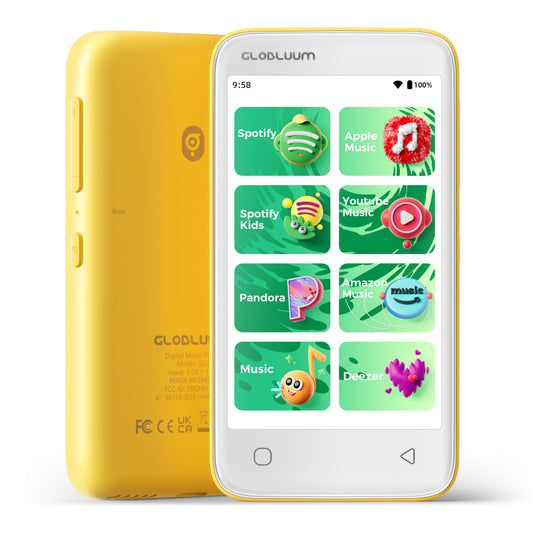
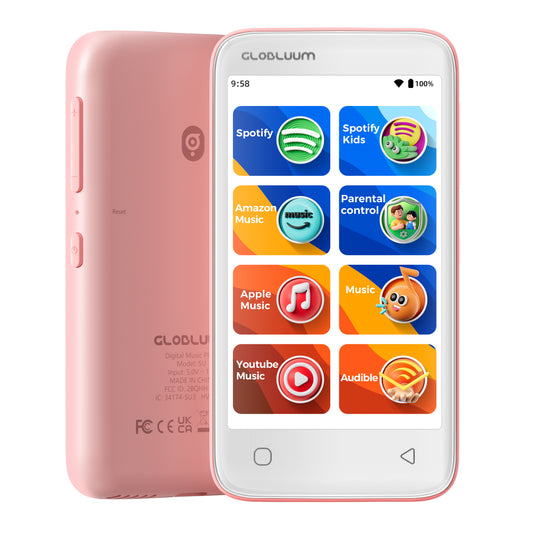
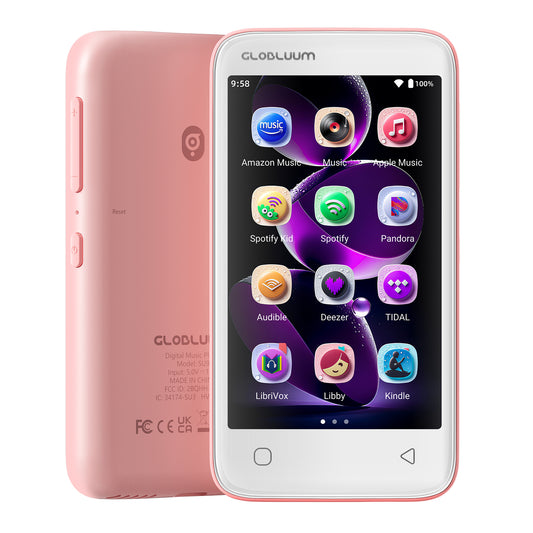
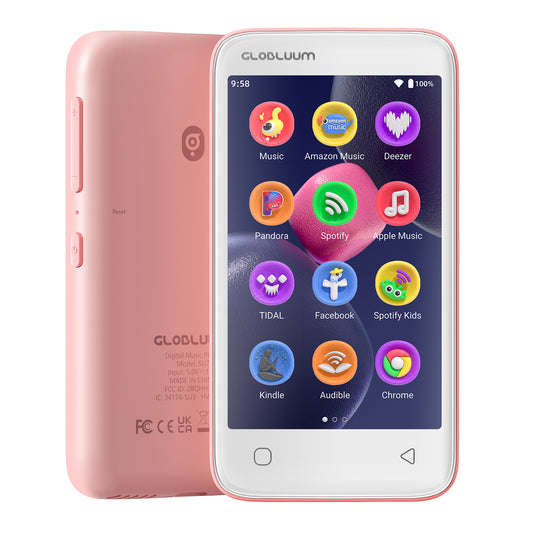
A device like Globluum is built for this smaller purpose: music, audiobooks, and stories — with clearer boundaries than a smartphone.
It gives kids a way to enjoy audio content without handing them the open internet too early.

My Son’s First Phone
Ten years ago, I was not strongly against children using smartphones.
Today, many parents might feel uneasy hearing that. A child under ten with a phone? Wouldn’t he get addicted? Wouldn’t he secretly play games? Watch short videos? Stop reading? Stop doing homework properly?
Honestly, I did not feel that worried back then.
To me, a phone was just a tool.
When my son was little, he asked me all kinds of questions. Some I could answer. Some I could not. After he had a phone, he could search, read, watch, and find some answers on his own.
Slowly, I noticed that his questions began to change.
When he was younger, he might ask:
“When I fall asleep, will the moon come down and tickle me?”
Later, it became:
“Is quantum entanglement what a higher-dimensional space looks like when it appears in three dimensions?”
He used to ask:
“Why is Scar from The Lion King so mean?”
Later, he asked:
“Why did Andy play The Marriage of Figaro in The Shawshank Redemption?”
I know those questions did not come only from the phone.
But the phone did open a door for him.
So for a long time, I did not see smartphones as something frightening. I even believed that, if a child used one well, a phone could help him see a larger world.
The Rules We Made Together
One reason I was not afraid of the phone was simple: in our home, the phone never existed without boundaries.
I tried to give him what I could, but I also wanted him to understand that not everything we want should be bought.
I gave him freedom, but freedom never meant doing whatever he wanted.
We had rules.
Homework had to be finished.
He had to go outside and move his body every day.
Video games were limited to 30 minutes at a time.
Phone time had boundaries.
Bedtime was bedtime.
Reading time was reading time.
Inside those boundaries, he had his freedom.
But if he crossed the boundaries, he would lose things he liked.
This was not some brilliant parenting method.
Most of the time, it was just an ordinary agreement between a father and a son.
We also made small agreements about money. I would tell him honestly how much I earned each month, and we would talk about what was worth buying and what was not.

Ordinary Life
Life is not made only of rules and agreements.
No one’s life is calm and well-organized all the time.
When my son walked with me outside, I would tell him about the hard parts of running a company: cash pressure, delayed products, and the coworkers I still found myself complaining about after I got home.
Sometimes, when a new product did not sell well, I would tell him:
“Dad’s pay is going to be smaller this month. That LEGO set you wanted may have to wait.”
He would ask:
“Are you going to lose your job? Is it hard to find another one?”
I would tease him too:
“You’ve gained some weight lately. I’m not sure your 400-meter record at the school track meet is safe anymore.”
He would fire back immediately:
“Your snoring is so loud I can hear it from the living room.”
Some nights, when I was too tired, I would say:
“Can you wash the dishes tonight?”
He would say:
“I washed them yesterday. Unless you buy me a Beyblade.”
That was our life.
There were big questions, and there were tiny everyday negotiations.
Sometimes we were father and son.
Sometimes we were friends.
Sometimes we were just two people living under the same roof, complaining about life together.
Helplessness and Small Heartbreaks
Many friends have told me that I am a strong father.
They have also told me that I have a good son.
But I know the truth.
I rarely treated him like a child who understood nothing. In many ways, he was my little friend, and I was his big friend.
I let him see the real adult world.
And he let me see his small private world.
I would tell him that I had spent an entire afternoon negotiating a contract, only for it to fall apart at the end.
He would tell me that the girl he liked had stopped talking to him.
Online, the dances never stop.
Real life, though, often moves with heavy feet.
And because our life had so many real things in it, the phone never became a very important character in my son’s childhood.
The phone was there.
But it never became his whole world.
Then I Began to Understand Why Parents Fear Phones
Later, I started to see a different kind of child around me.
Some children had a phone in their hands every waking moment.
At dinner, their parents had to call them again and again before they would finally put the phone down.
They talked less and less with their parents.
When they did speak, their words sounded as if they had been borrowed from TikTok.
It did not sound like the voice of a child anymore.
Children who used to run, jump, and play slowly stopped moving much.
Children who used to sit with a book could barely finish homework without distraction.
Long reading almost disappeared.
The hardest part to watch was what happened when parents took the phone away.
Anger.
Arguments.
Slamming doors.
Sometimes even serious conflict between parent and child.
That was when I finally understood why so many parents see smartphones as something dangerous.
It is not because they do not understand technology.
It is not because they are old-fashioned.
It is not because they want to keep children away from the world.
It is because they have watched their children slowly change.
That change does not happen in one day.
It happens quietly.
At first, you think the child is just a little impatient today.
Later, you realize he does not want to talk much anymore.
Then one day, you realize he can barely leave the screen.
That is when fear arrives.
Parents are not only afraid of the phone itself.
They are afraid that their child’s attention, language, emotions, patience, body, and relationship with the family are being reshaped by what is inside the phone.

The Phone Is Not the Whole Problem
I later understood something important.
My son was not unharmed by the phone because phones carry no risk.
He was unharmed because his life had many things that were more real, richer, and more attractive than the phone.
He had movement.
He had music.
He had rules.
He had conversations with his father.
He had a family where secrets and worries could be spoken out loud.
He had interests in the real world.
He had questions he actually cared about.
So for him, the phone stayed a tool.
But not every child lives that way.
If a child does not have enough real things in life — no movement, no music, no reading, no deep conversation, no steady rules — then the phone becomes very powerful.
Because the phone understands human weakness too well.
It does not need a child to become better.
It only needs the child to keep going.
It does not need to give real happiness.
It only needs to give one small hit of stimulation after another.
One video ends, and the next one appears.
One joke passes, and another one replaces it.
The child does not need to wait.
He does not need to think.
He does not need to be patient.
He does not need to deal with the real world.
He only needs to swipe.
That is what I became afraid of.
Not the phone as a tool.
But the possibility that a child might not have built his own world yet, and the phone would arrive first to build one for him.
When a Child May Not Be Ready for a Smartphone
Not every child needs to be kept away from phones.
But not every child is ready for a full smartphone.
If a child simply wants to listen to music, Spotify, Audible, or bedtime stories, he may not need a phone.
If a child does not yet have stable self-control, or rules he is willing to respect, a full smartphone may be too much, too soon.
In that moment, what parents need may not be another “safer phone.”
They may need something smaller, simpler, and clearer.
That is why many parents begin searching for a smartphone alternative for kids.
They are not trying to keep children away from technology.
They are trying to find a slower, quieter, and safer way for technology to enter their child’s life.
Why Music May Be a Better First Device
When I first started Globluum, it was not because I was afraid of phones.
I simply loved music.
I have always believed that music is one of the most beautiful things human beings have created.
Not only music, of course. Films, books, stories, paintings — these things are beautiful too.
When my son was very young, I already believed one thing:
Helping a child recognize what is beautiful matters more than giving him more things.
Giving a child more things may make life easier for a while. But helping a child recognize what is beautiful may shape the way he lives for much longer.
If a child does not know what is beautiful, he will often choose only what is more stimulating.
A bigger screen.
More games.
Shorter videos.
Faster pleasure.
Easier satisfaction.
Those things are not hard to find.
What is harder is this:
Can he be moved to tears by a violin piece he is too young to fully understand?
Can he sit alone on the couch for an hour after hearing a story, doing nothing but thinking?
Can he finish a movie and insist on discussing with me whether freedom or dignity matters more?
Can he come home from sports and proudly show me the knee he scraped?
Can he be rejected by the girl he likes and still remain gentle and decent?
A phone cannot easily give a child those things.
Parents have to help him see them.
Life has to teach him slowly.
Music, stories, and art are only a small part of that education.
But they are an important part.
A Music Player Is Not Built to Beat the Phone
I have to admit something very real.
Compared with a smartphone, a music player is not nearly as attractive to a child.
Music is not as stimulating as short videos.
Audiobooks are not as instantly fun as games.
Stories are not as addictive as social media.
A dedicated music player cannot open everything the way a phone can.
But over time, I began to think that maybe this is exactly its meaning.
A good device for children should not try too hard to capture them.
It should not make a child unable to put it down.
It should not become the center of childhood.
It should do its job, and then quietly step back into the background of life.
If a child wants to hear a song, he hears a song.
If he wants to listen to a story, he listens to a story.
If he wants Audible in the car, he listens to Audible.
If he wants soft music before bed, he listens for a while.
And after that, he can still go outside.
Do homework.
Talk with his parents.
Stare into space.
Like someone.
Live his own life.
That is enough.
So Globluum was not built to defeat the smartphone.
I do not think that is possible. I do not think it is necessary.
We are trying to do something smaller and quieter:
Give children a way to listen to music, audiobooks, and stories without handing them a full smartphone too early.

Final Thought: Children Need a World Worth Loving
I am not saying that no child should ever have a phone.
That would not be honest.
My own son had a phone before he was ten, and it did not ruin him. In some ways, it helped him see a larger world.
But I also will not pretend that every child can use a phone the way he did.
That would not be honest either.
Some children are not ready.
Some families are not ready.
Some parents are not careless; they simply cannot stand beside their children every minute of the day.
And some children, once handed a full smartphone, are easily pulled away by everything inside it.
So between “no device at all” and “a full smartphone,” I believe there should be a gentler choice.
I often think that what a child truly needs is not always a more powerful device.
What he needs is a world worth loving.
If that world is rich enough, the phone remains a tool.
If that world is empty, the phone becomes everything.
I wanted my son to know what is beautiful.
And I hope more children can hear something beautiful before they hold the whole internet in their hands.
That is why I built Globluum.
FAQ: Smartphone Alternative for Kids
1. Can a traditional MP3 player still meet a child’s needs?
A traditional MP3 player can still work well if your child only listens to downloaded local music files.
But many children today are already used to streaming apps such as Spotify, Spotify Kids, Apple Music, Amazon Music, YouTube Music, TIDAL, Deezer, Audible, and other music or audiobook apps.
For these families, a traditional MP3 player may feel too limited.
Globluum is a streaming music player built on Android 14. It supports popular music, audiobook, and story apps, so children can listen in a way that feels familiar, while parents still have clearer boundaries than they would with a regular smartphone.
2. Is an Android music player just another mini smartphone?
No.
Globluum uses Android, but it is not designed to be a mini smartphone.
It cannot make phone calls. It is not built for social media, gaming, or open internet use. It does not come preloaded with social media or messaging apps such as TikTok, Instagram, Facebook, or WhatsApp.
Android is used so apps like Spotify, Apple Music, Amazon Music, Audible, and other audio apps can run properly.
In other words, Globluum is a music and audiobook device, not another kids’ phone.
3. Can children secretly install apps by themselves?
Globluum is designed with parental control in mind.
Parents can manage which apps are available, check how long the device is used each day, see which apps have been used, and set downtime so the device cannot be used during certain hours.
Parents can also limit higher-risk functions, such as installing third-party APK files, factory reset, and USB file transfer.
This makes Globluum different from a regular smartphone or tablet.
On a regular device, children may keep finding new ways into games, browsers, short videos, or social media.
On a dedicated music player, parents can decide in advance what is allowed, what is not allowed, and when the device can be used.
It is not another “kid phone.” It is a music device with clearer content boundaries.
4. What age is Globluum suitable for?
Globluum can be used by children of different ages, depending on how parents set it up.
For younger children, parents can use it for nursery rhymes, bedtime stories, audiobooks, or offline cartoons stored on a TF card.
For older children, it can be used for Spotify, Spotify Kids, Apple Music, Amazon Music, Audible, and other music or audio apps.
Many teens, college students, and adults also use streaming music players for study, commuting, work, focus, and distraction-free listening.
Over the years, we have sold close to one million Android streaming music players. Based on real customer feedback, common use cases include children listening to music and stories, students studying with music, and adults using music to focus at work.
5. Does Globluum support Wi-Fi?
Yes.
Globluum supports Wi-Fi, so children can stream music through apps such as Spotify, Apple Music, Amazon Music, YouTube Music, TIDAL, and Deezer. Wi-Fi also makes it easier for parents to set up and manage supported content.
But Wi-Fi support does not mean the device works like a regular smartphone.
With parental controls, parents can decide which apps are available, whether app installation is allowed, and when the device can be used.
For a streaming music player, Wi-Fi is mainly there to make music and audio content easier to access — not to give children the whole internet.
6. Can children download other apps?
By default, Globluum is not meant to be an open app-installation device for children.
If parents want to allow additional apps, they can manage app permissions through parental control settings.
For younger children, we recommend keeping the app list simple and limited to music, audiobooks, bedtime stories, and other parent-approved content.
This is one of the main differences between a dedicated music player and a regular Android phone.
A regular phone gives children an open door.
Globluum gives them a boundary parents can set first.
7. Does Globluum support offline music playback?
Yes.
If you own digital music files, you can copy them from a computer or phone to a TF card and play them through the preinstalled HiBy Music app.
Some streaming apps may also support offline downloads, depending on your subscription plan, account type, region, and the rules of each app.
For example, Spotify, Apple Music, Amazon Music, Audible, and similar apps may allow users to download music or audiobooks for offline listening if the account supports it.
This makes Globluum useful for car rides, flights, travel, bedtime, or places where Wi-Fi is not always available.
8. What accessories are included with Globluum?
Globluum usually includes a protective case, wired earphones, a charger, and a user manual.
The protective case helps reduce the risk of screen damage from drops.
Wired earphones are useful for simple listening, and the player also supports Bluetooth headphones and speakers.
For younger children, we recommend that parents help set a safe and comfortable volume level before use, especially when children are using headphones.
9. Is Globluum a good smartphone alternative for kids?
Globluum can be a good smartphone alternative for kids when the child mainly needs music, audiobooks, bedtime stories, Spotify, Audible, or other audio content — but does not need a full smartphone.
It is not a complete phone replacement.
It is not made for phone calls, texting, social media, gaming, or open internet use.
It is made for families who do not want to give a child a full smartphone too early, but still want the child to have music, stories, and audio content.
For many parents, the value of Globluum is not that it is more powerful.
It is simpler, quieter, and easier to set boundaries around.