How Can Kids Listen to Spotify Without a Phone? (Parent’s Guide)
Parents today are asking a surprisingly similar set of questions:
Is there a Spotify player for kids?
Is Spotify Kids actually good enough?
And most commonly: My child loves Spotify—but I don’t want to give them a smartphone. What are my options?
At first glance, these seem like different concerns.
But over time, we’ve noticed something important:
They are all trying to solve the same tension —
a child’s growing need for music, and a parent’s growing concern about smartphones.
This is not really a “music app problem.”
It’s a device boundary problem.

Why More Parents Are Reluctant to Give Kids a Phone for Spotify
A decade ago, the concern was mostly gaming.
Today, the environment is fundamentally different.
Short-form videos, algorithm-driven feeds, social media loops, constant notifications — these systems are not just entertaining. They are designed to hold attention.
And music, once a simple listening experience, now sits inside that ecosystem.
One parent from the U.S. once wrote to us:
“I only wanted my child to listen to music. Somehow, I ended up giving them the entire internet.”
What makes this sentence powerful is not emotion — but accuracy.
Because in most cases, parents are not resisting music. They are resisting what music is bundled with.
And that distinction matters.
Can Kids Listen to Spotify Without a Phone? Yes—But Each Option Has Trade-offs
The short answer is: yes.
But what we’ve learned from talking to families is this:
There is no “perfect” solution — only different compromises.
Option 1 — A Home Computer
For many families, this is the default starting point.
Spotify works well on a browser or desktop app, and there is no extra cost.
For occasional listening, it is perfectly functional.
But the limitation is structural:
A computer is not designed for mobility, and it still sits inside a full internet environment.
So while it removes the phone, it does not really reduce distraction — it only relocates it.
Option 2 — A Tablet (iPad or Android)
At first, tablets feel like a safer alternative.
Larger screen, easier to manage, often “handed down” from parents.
But in practice, most families discover the same pattern:
A tablet is not a simplified device. It is a scaled-up smartphone experience.
Video apps, games, browsers — everything remains available.
So the question shifts from “no phone” to “bigger phone.”
And that does not solve the core issue.
Option 3 — Smart Speakers
Smart speakers work well for passive, home-based listening.
Once connected to Spotify, music becomes instant and effortless.
No screen. No navigation. No friction.
But there is a trade-off that becomes clearer as children grow:
It is shared, not personal.
Music becomes part of the room, not part of the child’s identity or mobility.
For many kids, especially as they get older, that distinction becomes important.
They don’t just want music playing.
They want their own music space.
Option 4 — Kids’ Smartwatches
Some children’s smartwatches now include limited music functionality.
For younger children, this can work as an introduction.
But realistically:
- Spotify integration is often partial
- Controls are simplified to the point of limitation
- Audio experience is secondary to communication features
So in most cases, these devices are not designed for music-first usage.
They are communication tools with music as an add-on.
Option 5 — Dedicated Spotify Music Players
This is where we’ve seen the most meaningful shift in recent years.
A new category of devices has emerged — sitting between traditional MP3 players and smartphones.
They are designed with a very specific assumption:
A child does not need a general-purpose internet device to enjoy music.
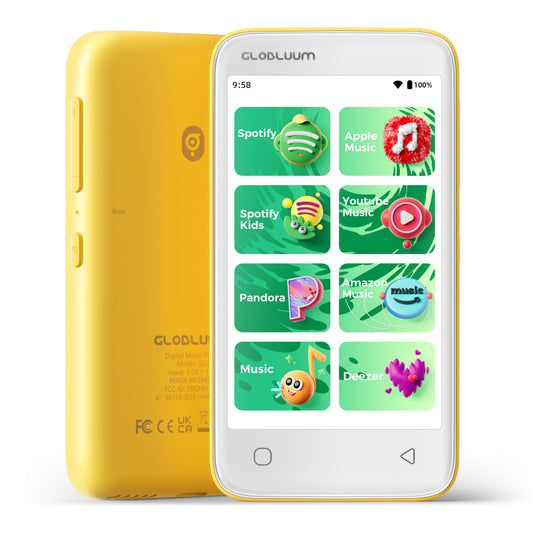
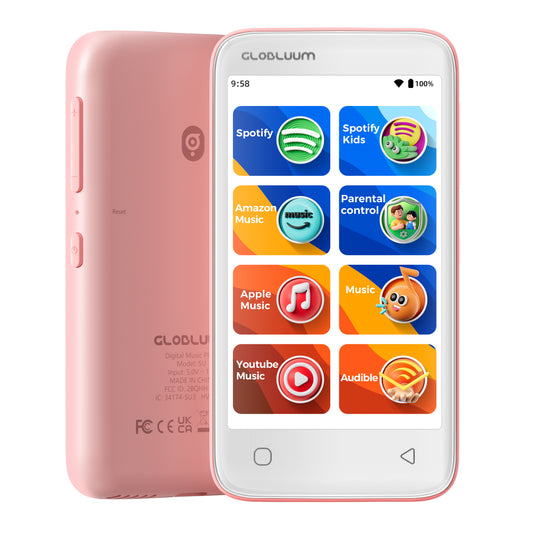
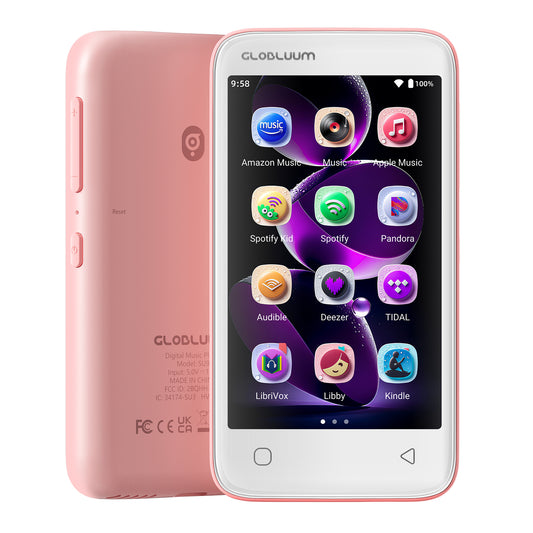
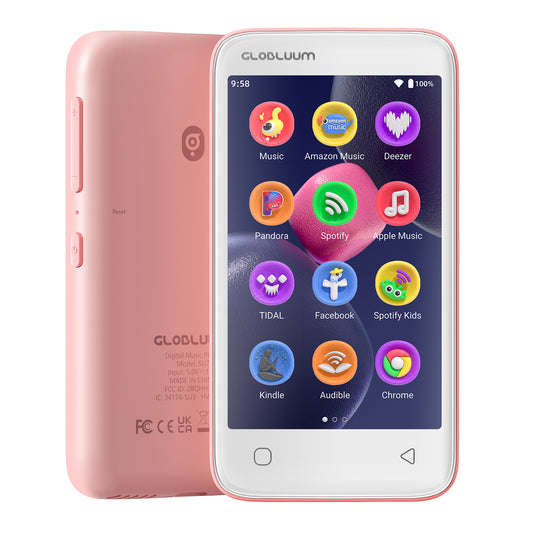
Instead, they focus on streaming services like Spotify, Spotify Kids, Apple Music, and audiobooks — while deliberately reducing everything unrelated to audio.
This is the direction we’ve focused on at Globluum.
Not because it is a “new gadget category,” but because it solves a very specific mismatch between intent and device.

Why We Started Building Dedicated Music Players
From the outside, a music player looks simple.
But once you start speaking with parents consistently, a pattern becomes clear:
The problem is not lack of features.
It is lack of boundaries.
Parents rarely ask for more functionality.
They ask for clarity:
- Can it play Spotify?
- Can it support audiobooks?
- Can it be restricted during study or sleep time?
- Can games and social apps be prevented entirely?
- Can it avoid becoming a smartphone in disguise?
These are not technical questions. They are structural ones.
And they shaped how we approached product design from the beginning.
The Real Issue Is Not Spotify—It Is Control
One of the most consistent insights we’ve seen is this:
Parents are not afraid of music consumption.
They are afraid of uncontrolled expansion.
Once a device enters a child’s hand, its purpose often expands beyond its original intent.
That is why parental control is not a “feature layer.” It becomes the core architecture.
In practice, this may include:
- Daily usage visibility for parents
- App-level usage tracking
- Scheduled lock periods (study, sleep, offline time)
- Restricting installations and third-party apps
- Preventing system-level changes without permission
From a pure product perspective, these may seem excessive for a “music device.”
From a family perspective, they are often the reason the device is acceptable in the first place.
Because what parents are really evaluating is not the device itself.
It is whether the rules they set will actually hold.

Why Dedicated Music Players Are Gaining Adoption
For years, the default approach was to add restrictions on top of smartphones.
But more families are now reversing that logic.
Instead of asking:
“How do I make a phone safer?”
They are asking:
“Do we actually need a phone for this use case?”
Once that question changes, the solution space changes completely.
A dedicated music player is not trying to replace a phone.
It is trying to redefine the entry point.
Not earlier exposure. Not total isolation.
But a controlled first step into digital audio.
Boundaries, Not Devices, Are the Real Solution
Over time, this has become the most important conclusion we’ve reached:
Most families do not want to remove technology.
They want to define it.
- When can it be used?
- What is allowed?
- What is permanently excluded?
- Who controls those rules?
When these boundaries are clear, music returns to being simple again.
And the device returns to being what it should be:
A tool that serves intent, not attention.
Conclusion
If your child enjoys Spotify but is not ready for a smartphone, you are not alone in that situation.
What we are seeing across many families is not rejection of technology, but a search for a more precise relationship with it.
For some, a computer or smart speaker is sufficient.
For others, especially those who want to delay smartphone exposure while still giving children independence in music, a dedicated music player offers a more intentional alternative.
This is the direction we continue to explore with the Globluum product line.
Not because children need fewer songs.
But because they need clearer boundaries around how those songs are experienced.