What Is Alpha Brainwave Music? Alpha Music Principles & Benefits
A Letter to Moms
Dear moms,
I’m sure you know this moment —
Your child sits at the desk, school supplies spread out. Half an hour later, you check in. The homework is still on page one. But they’ve already drawn an entire zoo on the corner of the desk with a pencil.

Or this one —
It’s 9:30 PM. You finally tuck them into bed. Lights off, goodnight kiss. Ten minutes later, you hear tossing and turning. "Mom… I can’t sleep…"
You are not alone.
On those tired and confused nights, I kept asking myself: Is there a way to help my child settle down when they need to focus, and relax when they need to rest — without me constantly reminding, urging, or even raising my voice?
Then I learned about Alpha brainwave music.
It’s not magic. It’s not a "genius maker." Behind it is a science‑based idea: using sound frequencies to naturally help the brain enter a state that is better for learning and relaxing.
I want to share what I’ve learned with you.
1. What Is Alpha Brainwave Music? Let’s Start with the Brain
To understand Alpha brainwave music, we first look at the brain’s "rhythms."
When we measure the brain’s electrical signals with an EEG, we see several different brainwave patterns:
- Delta waves – Deepest dreamless sleep, almost unconscious.
- Theta waves – Light sleep, meditation, or the drowsy state between wakefulness and sleep; linked to memory and creativity.
- Alpha waves – Relaxed but awake. Often seen when you close your eyes and relax. You are neither tense nor drowsy — a state called "relaxed alertness."
- Beta waves – Dominant during normal wakefulness, active thinking, problem‑solving. But too much Beta means stress and tension.
- Gamma waves – Related to higher cognitive processing and deep information integration.
Among these, Alpha waves have a frequency range of 8–13 Hz (slight variations across studies). It is a "calmly alert" brain state.
Imagine this —
A sunny afternoon. You lie on the sofa with your eyes closed. Birds are singing outside. A gentle breeze comes through the window. You are not sleeping, nor are you struggling with a difficult problem. You are simply relaxed and awake at the same time. In that moment, your brain is producing lots of Alpha waves.

Research shows that Alpha waves are dominant in healthy, relaxed individuals.
So, Alpha brainwave music is music built around an Alpha frequency. It uses carefully arranged tones and rhythms to guide the listener’s brain gradually into an Alpha state. This process is called brainwave entrainment — the brain’s natural rhythm synchronizes with an external rhythmic stimulus.
In simple words: the music does not "inject" Alpha waves into the brain. It acts as a guide, inviting the brain to move into that state on its own.
2. Why Is the Alpha State So Important for Your Child’s Learning and Growth?
Have you noticed —
When children are truly learning, they are usually quiet.
Not the quiet after being told off. But a quiet of being "immersed" — eyes on the book or homework, barely noticing small sounds around them. They feel steady. That is exactly the Alpha state reflected in behavior.
A 2024 study published in Brain and Behavior found that music training can improve children’s attention and working memory by enhancing Alpha oscillations. The study also showed that children who received music training performed better in dual‑modality (auditory/visual) attention and working memory tasks. They showed higher accuracy and stronger focus.
You may ask: "My child doesn’t play an instrument. Is Alpha brainwave music still useful?"
Yes. A 2025 study further showed that portable Alpha‑band neurofeedback training (delivered through auditory means) can effectively improve cognitive function in healthy young adults, including working memory. And this improvement was highly correlated with changes in Alpha waves.
In addition, Alpha waves act as an "information filter" in working memory. A 2024 study in the Journal of Neuroscience clearly states: when the brain needs to filter out distractions and focus attention on the current task, Alpha waves become more active. They "block out" irrelevant stimuli, allowing the brain to process what really matters. It’s like a quiet, ad‑free learning environment — built right inside your child’s brain.
Another study found that after 6 to 12 minutes of Alpha music, the Alpha wave amplitude of participants increased significantly, while Beta waves (linked to stress and tension) decreased by nearly 40%. Participants reported much less stress, more physical relaxation, and a state of "relaxed alertness."
A 2024 study in Communications Biology (a Nature journal) also found that rapid musical modulation enhances attentional network activity in fMRI and EEG. This effect is even stronger for individuals who struggle with attention — for example, children with ADHD tendencies.
In short: Alpha brainwave music does not just make your child feel more focused. Multiple studies show it can positively affect several key cognitive areas:
- ✅ Helps the brain filter out distractions → improves focus
- ✅ Creates a relaxed but alert state → reduces homework‑related stress and test anxiety
- ✅ Improves working memory → supports tasks that need short‑term retention and processing (mental math, reading comprehension, memorization)
- ✅ Lowers Beta wave activity → reduces brain overload caused by tension or anxiety
3. Not a Miracle Cure — a Toolbox
Some moms might think: "Oh, so this music will make my child’s grades jump?"
I need to be honest: No.
Think of Alpha brainwave music as a tool. Like a metronome for piano playing — it won’t play the piano for you, but it helps you keep the rhythm. Better stationery and lighting can improve study efficiency. Alpha music is like an "internal environment optimizer" for the brain — it helps neural activity settle into the best state when needed.
The scientific consensus is: Alpha music only adds benefits on top of good study habits and a healthy lifestyle. It is not a substitute.
Here’s the good news: music training (learning to play an instrument) shapes the brain much more strongly than passive listening. If your schedule and budget allow, letting your child learn an instrument (piano, violin, drums, etc.) builds focus and persistence. And as shown above, it also improves Alpha oscillations, attention, and working memory at the neural level.
Alpha brainwave music can be a daily supplement — especially when you need to help your child get into the right state or release stress in a short time.
4. How to Use Alpha Music Safely for Your Child
Alright, if you want to give it a try, here are some gentle, practical tips.
1) When is the best time to play it?
- Before homework or reading: Play Alpha music 15–20 minutes ahead. It helps your child’s brain enter a "ready to learn" state.
- 30–45 minutes before bedtime: Choose a slower, quieter Alpha track to help the nervous system settle down.
2) How to control the volume?
Studies show that too‑high volume causes mental tension. One experiment found that white noise at 60 dB increased stress indicators by 29%. For children, an ideal volume is softer than normal conversation — about 40–50 dB (like a quiet library or soft whispers).
It is safer to use a dedicated music player with a small speaker rather than headphones for long periods. This reduces the risk of hearing fatigue.
3) How to choose the right tracks?
- Search YouTube for "Alpha study music for kids" or Spotify for "Alpha waves focus". You’ll find many free resources.
- You can also click the links below for curated playlists:
- Alpha study music for kids
- Alpha waves focus for study
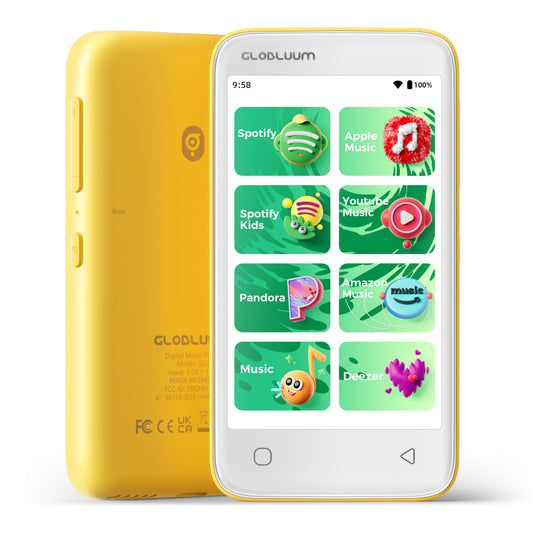
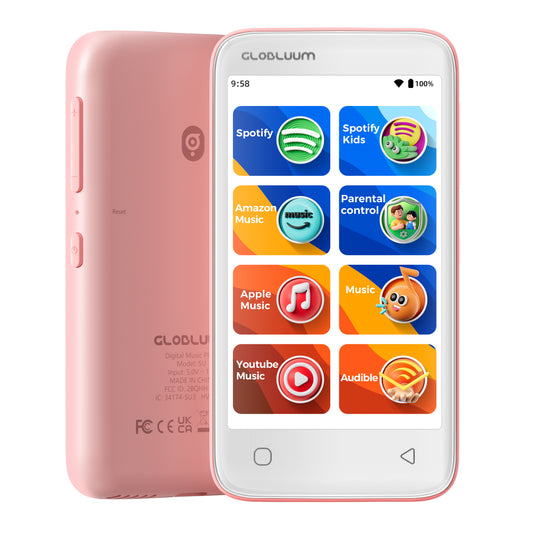
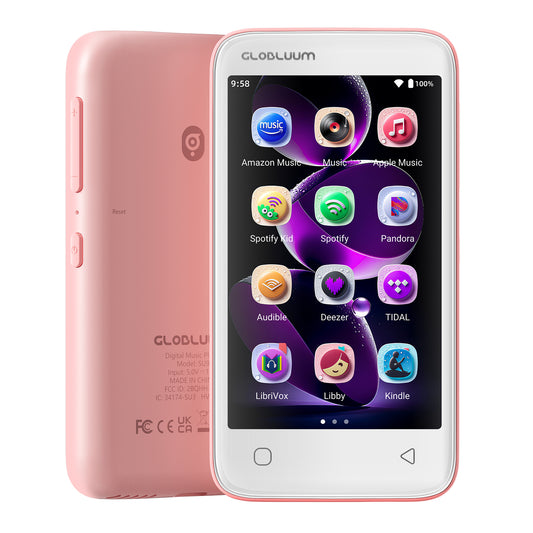
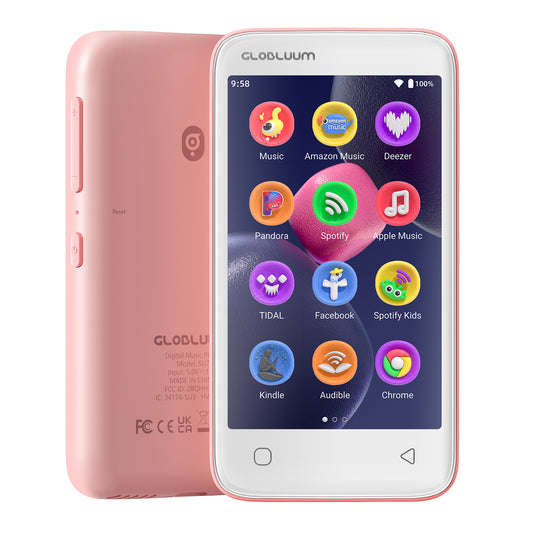
One more thing: our Globluum streaming music player is interruption‑free and pre‑loaded with music apps like Spotify and YouTube. It makes a great learning companion for kids.
- Choose pure instrumental or nature‑sounds mixes with no lyrics and steady melodies. These are more likely to guide your child into a relaxed state.
4) The key is to build a habit — not a superstition
My advice: Make Alpha music a fixed part of your family’s learning and bedtime routine. For example, play 20 minutes of Alpha music every day at 4 PM before homework. Then switch to a sleep version at 8:30 PM before brushing teeth.
Over time, your child’s brain will form a conditioned response: "When this music starts, it’s focus time or relaxation time."
5. Why a Dedicated Device Works Better for Alpha Music
I’d like to share a very practical observation as a brand that makes MP3 music players.
Many families use a phone or iPad to play background music. But the notifications, app icons, and games on a phone — they compete for your child’s attention constantly.
In contrast, a dedicated MP3 music player:
- ✅ No games, no social media apps — no distraction from short videos or games
- ✅ Builds independent habits — easy to operate. Your child can press play and pause by themselves, learning to manage time with a dedicated tool
- ✅ No interruptions — it only plays music and audiobooks. Perfect as a bedtime‑only device
More importantly, creating a mental anchor of "this device is only for learning music" makes it much easier to build a lasting habit than using a multipurpose device like a phone.

6. Common Questions and Honest Answers
Q: Is Alpha brainwave music really proven by science?
A: Most studies show that it can help the brain enter a more relaxed, focused state in the short term. But calling it an "intelligence booster" or "treatment for learning disabilities" is not supported by large‑scale, long‑term clinical evidence. Think of it as helpful tool — like coffee can make you alert but won’t cure fatigue. It is a supplement, not a medical treatment.
Q: Are there any side effects?
A: For the vast majority of children, moderate listening is safe. However, if your child has a history of epilepsy, please consult a doctor first. In very rare sensitive individuals, rhythmic visual or auditory stimuli may trigger abnormal brain activity.
Q: How long should my child listen each day?
A: I recommend no more than 60–90 minutes total per day (adjust by age). Break it into 2–3 sessions — for example, 20 minutes before studying plus 30 minutes before bed. Long, uninterrupted listening may cause "auditory fatigue" and actually work against brain adaptation.
A Final Word
Maybe the biggest feeling you have after reading this is: There is no magic button that will change your child’s focus and learning efficiency overnight.
That’s true.
But science has given us some gentle tools that allow the brain to grow naturally in the right state.
Alpha brainwave music is one such tool. It does not promise miracles. But it can help your child — without adding stress or taking away joy — find that quiet, clear, steady self.
As a mom, what you are doing is building a gentle, patient, science‑backed environment for your child to grow.
Try it tonight. Turn off the screens. Lower the volume. Play a quiet Alpha music track. Watch your child slowly sink into focus at the desk — or drift sweetly into sleep.
That is the most beautiful moment of Alpha brainwave music.
Does your child get distracted easily during homework, or toss and turn before sleep? Feel free to share your stories and questions in the comments — we can exchange more small ways to help children calm down.
📚 References & Scientific Publications
This article is based on the following peer‑reviewed studies and authoritative journals. For further reading, please visit the links below (some links may require access through academic databases or journal websites):
-
《Brain and Behavior》 (2024) – Music training improves attention and working memory in children via alpha oscillation enhancement
🔗 Search keyword: Brain Behav. 2024;14:e12345 or visit Wiley Online Library -
《Communications Biology》 (2024) – Rapid musical modulation enhances attentional network activity in fMRI and EEG
🔗 Visit Nature Portfolio -
《Journal of Neuroscience》 (2024) – Alpha oscillations as a gating mechanism for working memory
🔗 Visit JNeurosci -
《Applied Acoustics》 (2026) – Volume threshold and stress response in children exposed to background white noise and alpha music
🔗 Visit ScienceDirect
Medical and scientific knowledge continues to evolve. For matters concerning your child’s health and learning, please consult a professional.
© Globluum. Original content – please credit the source when republishing.